Sunday, November 1, 2009

Marlburian infantry units in review

Today I finally managed to spend a few hours to fix some final details on my Marlburian armies, and I also had the opportunity to take some long-due photos of the final results of, literally, months of work. I am very pleased by how things are shaping up in this project. of course, I would have liked to proceed faster, but overall I cannot complain. Life has been busy, really busy: and yet, I have succeeded in bringing several units to the table -- literally.

Right now, the bulk of my Marlburian forces are in two armies: the one of the Elector of Palatinate, and one French. ideally, I will probably develop an imagine-nation narrative when the time to deploy them will come, but for the time being I am glad to keep them both relatively historical.

For the Palatinate forces, I also manage to paint a commander, maybe the Elector himself. You cans ee him here, all smiles after a full staisfactory review of his troops. These are 15mm Edition Brokaw miniatures.

Thus far, I have completed five Palatinate regiments, based on 12 miniatures per regiment: IR Bettendorf and IR Rehbinder (blue coat with red cuffs); IR Haxthousen and IR Westerwald-Dillendurg (blue coat, green cuffs); IR Saxe-Meiningen (red coat, green cuffs.) Here the five units:

For the time being, only one Palatinate cavalry regiment has been completed, RR Hochkirk, while two other cavalry units are in the pipeline, one dragoons and one cuirassiers (the Gendarmes de Venningen.) Here's Hochkirk's cavalrymen:


The French units have been completed in a more free-wheeling, unsystematic manner. Thus far, I count four "regular" infantry regiments: Normandie, Piedmont, Perche, Enghien. In addition, there are two Irish units, Abermarle and Donnington, and one Swiss, Stuppa, plus some Spanish grenadiers (you can see them in the background in the second picture below, or here for a close-up during painting.)


What will be next? There are some items with very high priority. I need cavalry for the French; two units of dragoons are about to hit the workbench, and eventually one more of mounted musketeers. As I mentioned, there are two cavalry units for Electoral Palatinate that are almost completed, and I am considering an additional couple of Imperial cuirassiers. Then, I need artillery -- something is in the pipeline, but I need to hurry up... So, yes, still a lot of work is waiting for me. But, nonetheless, some very sweet progress as well!

Thursday, October 22, 2009

Naval teaser!

Life chez DestoFante has not been limited to sleepless nights and changing diapers! Wargaming time, in all honesty, has been minimal, as you might guess; but we had a few progress, about which I hope to update you soon in thorough manner. For the time being, just a teaser -- a naval teaser! Here a few WWI British warships just christened early tonight. These models are 1/6000 Figurehead, representing four Weymouth-class (Town-class) light cruisers, namely HMS Weymouth, HMS Dartmouth, HMS Falmouth, and HMS Yarmouth, and three Devonshire-class armoured cruisers: HMS Devonshire, HMS Hampshire, and HMS Carnarvon.


I hope to have the time to get back online soon with some pictures of my finally completed Marlburian units!

Friday, September 11, 2009

9/11

Having spent most of the day with my boss and professional colleagues sharing our recollections from this day eight years ago, I now find comfort in sitting back, serving myself a glass of wine, relaxing if possible, and thinking about this very same day, only three century ago.

Thanks to Grimsby for the reminder!

Thursday, September 10, 2009

Look who is here!


DestoFante Jr. was born at 12:20pm on August 30th!
Mom and son have been doing very well in the first 10 days, and maybe the day is not too far that the sleepless dad will retrieve brushes and paints from the closet and resume "normal" wargaming activities. In the meanwhile, this little angel is keeping us busy almost around the clock!

Tuesday, August 25, 2009

I dipped, and almost regretted...

I decided to dip... and I went close to a complete disaster.

First, a quick overview of my dipping technique, which is actually not a real "dip", as I use a brush to apply the Minwax Polyshade finish to my miniatures. I normally use a fairly large, cheap brush, and two types of Polyshade, one called "Antique Walnut", with a more reddish-brownish tint, which usually works great for red-clad miniatures, and the other with a blackish color, called "Tudor Satin", which works great for miniatures painted in gray and white as main color.

So, today I headed to the roof deck, armed with all the necessary to engage in a nice session. First I applied the Tudor Satin to the Spanish grenadiers, a Palatine regiment, and the French Piedmont and Normandie. So far, so good. But I didn't stir the Tudor Satin can much before applying the dip, so it came out as a relative "light" layer. When I moved to work to the Swiss and the Irish/Palatinate units, I made sure to stir more robustly the Antique Walnut, and... gee! It came out thick and dark brown, and covered everything, from bayonets to the white and yellow trim on the hat. I had to sweat quite a bit to thin the dip, and to remove as much of it as possible from the areas whose color I wanted to keep more vivid. And as I was working in this crucial cleaning action... the brush broke off! I was able to fix it on the fly, and to complete the cleaning/finishing strokes -- I just had to be very careful with the brush.

Photos will follow soon. For the time being, let me articulate the lessons of the day:

a. make sure the brush is in good condition; if it is, take a second one with me nonetheless, just in case;
b. use a smaller brush: it will make my work slower, but it will ensure I have better control of the amount of finish I apply to the miniatures;
c. try not to put any dip on the hats and the bayonets;
d. give the dip a few minutes to sit down, or stir more gently at the beginning. Go for a ligher mix. These are War of Spanish Succession figures, not colonial natives, duh!

Bottom line. The Swiss and the Palatinate/Irish came out a little darker than I would have preferred, but they are still nice. Normandie, Piedmont, Palatinate, and Spanish grenadiers look great. The day was saved!

Monday, August 24, 2009

More pic, and a question

[Apparently, blogspot is working again, and I can now continue the post abruptly interrupted a few minutes ago... make sure you read both this and the post immediately below in sequence!]
First, I want to share the pictures I promised when I posted the photos of the Milano grenadiers and the Piedmont and Normandie regiments earlier tonight.
The first picture shows the back side of the Stuppa men, followed by two close-ups of the Stuppa and Donnington officers. As you may notice, I am becoming more and more daring with the use of silver and brass on laces and uniforms, as well as on tin buttoms. Ehi, they look good to me, given than about one year ago I was still adamant in NOT wanting to paint XVIII century uniforms because "too complex and ornate"!


And now a question for you all, my friends.

Usually, I have come of the good habit to dip my miniatures before basing them. You may see some good example of my technique and final results here and here. But now, I confess to be torn. The dip may still provide a great effect on my infantrymen, but I am afraid that the dipping will partially cover my painting efforts, especially on the officers. So, I am almost tempted NOT to dip this time around. I need to think about this. Oh well... in the meanwhile, I can start some work on the cavalry. I have dragoons and cuirassiers waiting on the workbench!

Still waiting... but making the wait productive

First and foremost: DestoFante Jr. is taking his time. He should have shown up eight days ago, but so far, nothing. Nada. Niente. So, after a few days of excitement and heightened expectations, we are settling into a not exactly comfortable routine. I cut back on my hours at the office to spend more quality time with Mrs. DestoFante, who by now is bored to death and over-stressed, and understandably so.

In the meanwhile, somebody gotta kill some time...

And so, I took the brushes off and I re-started my weekly routine of slow but steady progress. Actually, this couple of days were more satisfying than most, because I finally completed different units in my Marlburian project that have been on the workbench for quite some time.
First, a Spanish grenadier unit, Milan Regiment. You may remember a Santa-looking unit from a post a while ago, but you will appreciate the better style of the completed grenadiers now that painting is concluded. These are 15mm Spanish grenadier from the GFI/Minifigs range.


Next, also from my favorite 15mm range by GFI/Minifigs, two French units, Regiment Normandie and Regiment Piedmont. In order, you will first see an infantry from Normandie, followed by two from Piedmont.


There are some more pics from the two red-clad regiments that complete this batch, the Swiss Regiment Stuppa and the Irish Regiment Donnington. Apparently, my blogspot connection is running to some trouble tonight, so you will have to wait until tomorrow... believe, it is worth the wait, because I took some artistic dares in painting these units (especially the officers), and I am very proud of the results!

Thursday, August 20, 2009

Dilemma

Every now and then I get trapped in some dilemma of sort about practical aspects of my wargaming projects, and that state of mind seems to drain energy from achieving further progress.

I stumbled on one of these blocks on a relatively minor issue concerning my Marlburian armies. Here's the problem: I am building my units in a modular fashion, so that, depending by the mood, the rules, or the battle, I will be able to deploy battalions or regiments with either 12 or 24 miniatures. Ideally, I would like to have all my infantry units made of 24 miniatures, but in a bout of realism, and taking into account the fact I live into an apartment and I play on a 6' by 4' table, I want to have the flexibility to opt for 12-miniature units. So far so good, as far as line infantry is concerned.

But what about grenadiers? I am fine with a 12-miniature grenadier unit; the problem is that a 24-miniature grenadier one looks... excessive, at least for the period (1700-1720.) Or isn't it? Am I wrong? I would feel comfortable with large grenadier units for later conflicts, like the Seven Years War: but what about this earlier age?

I am actually considering keeping all the Marlburian grenadiers in units of 12. They will be fine when deployed in a battle with other 12-miniature units, and they will still look OK when taking part in clashes with 24-miniature line infantry units (assuming that the whole idea of "line infantry" made any sense in this earlier period.) Or maybe I should sink myself in further readings about the period, and verify whether, historically, there is any ground to justify smaller count of men in grenadier units vs. regular infantry units.

On this problem, I got stuck: and no progress on my projects has been registered for a few weeks now.

Sunday, August 9, 2009

Exhausted, but I accomplished my mission!

And so Cpt. Agesilao Fantoni did, after several hours of tense action in the valley of Wekiro!

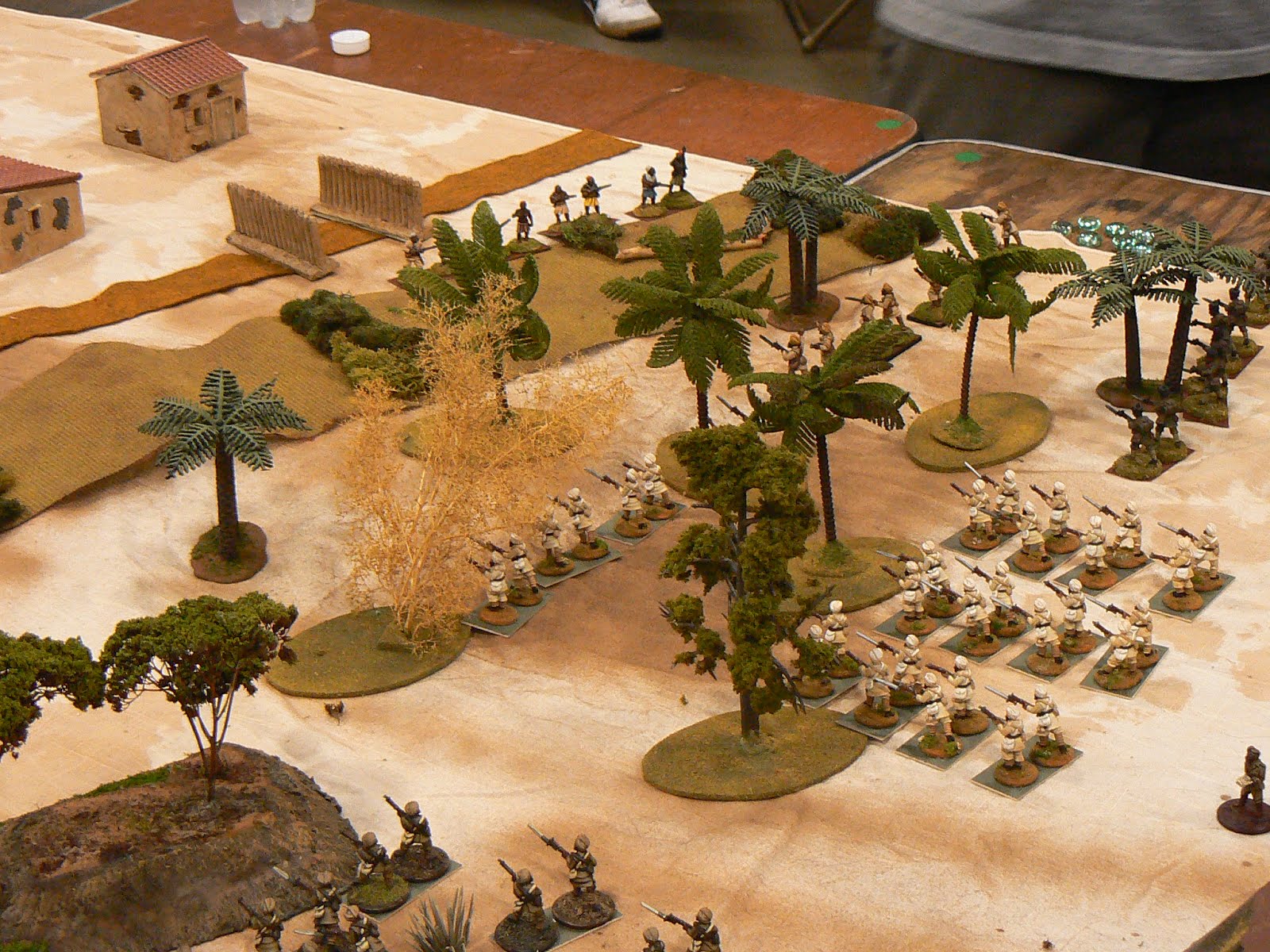
The game played out exceptionally well. I took several pictures that I will include in the final AAR. As a teaser, I will liberally sprinkle a few in the present notes, just to whet your appetite!

Photo-op: Fantoni's Force poses for a picture before leaving Monkullo.


Many solutions I experimented for the first time contributed to a fantastic experience.
  1. The integration of "Mythic Game Master Emulator" with "The Sword And The Flame" works smoothly, and added a lot of color and narrative threads to the "vanilla" game based on TSATF. Of course, there is room for improvement: the Random Event outcomes by MGME have a "fantasy" flavor that, with some work, can be corrected, so that the experience will feel more directly "colonial"; that said, it took very little effort to fold the random outcomes into a colonial narrative, thus, little complain here.

  2. The terrain looked good. Really good. And so did the miniatures. Probably my best looking game ever. Heck, having a blog, and a digital camera, and attentive readers, really forces you into doing your homework!

    The valley west of Wekiro: "a narrow valley with steep mountains on both sides, and a dried creek bed at the bottom".


  3. The story was solid, and, as I was hoping for, it opened several threads that might become the basis for a campaign, and future games.

  4. Fantoni's force advancing toward the village.


  5. It was a great idea to keep my computer on, and to jot down notes as the game developed. I have now several pages of a narrative that would make the AAR, hopefully, quite entertaining -- and not a chore as it is when I need to write everything from scratch one day or two after the fact.

Hostile presence in the village.


There were also a few, minor issues I was not completely satisfied with. As mentioned above, some of the tables in MGME may be improved, to provide outcomes whose interpretation is more straightforward in a colonial setting.

Abyssinian warriors holding the village.


Second, I didn't realize how rusty my TSATF memory was. I haven't played the game in quite some times, and I forgot some minor elements in the rules. Also, there were a couple of circumstances where I doubted how the situation should be handle, especially as far as point blank fire, and shaken and routing units are concerned. I need to brush up my TSATF for sure! Re-reading the rules tonight, after the action, will definitely help for the next game. Also, I'd like to make some personal notes -- flow diagrams to help my memory in dealing with a few cases.
Last but not least: as the game got going, I realized I was missing my d20 dice! They must have got lost in our recent move, as there was no way to find them anywhere. I'll tell you: playing TSATF 20th Anniversary Edition with one and one only d20 was a real pain! Likewise, one card was misplaced, but fortunately there was an easy fix and that problem did not have major consequence for the game.
A little regret for the missed opportunity to playtest "Colonial Adventures", which I did not have a chance to do today. Next time, I want to give these rules a try, definitely!

Abyssinian warriors meeting their fate charging the Italian infantry.


Next, I will work on an After-Action-Report. I may actually break it down in two parts, the first relative to the force entering the valley (in which RPG aspects will prevail), and the second about the fight with the Abyssinian bands (here it will mostly be a TSATF fight along the traditional standards.) And I need to sort through the several pictures of the game, to highlight the narrative. Busy days ahead!

Abyssinians charging the askaris.


[Apparently DestoFante Jr. is not due before next weekend, and all we have to do is sit down, relax, and wait... writing a detailed AAR may actually be very therapeutic!]

Cpt. Agesilao Fantoni enters the village followed by his troops.

Saturday, August 8, 2009

Orders have been issued!

I report the following orders, as they were issued yesterday afternoon. The original Italian text follows.

"Massawa, Eritrea Colony, August 8th 1889

I, the Commander, direct:
  • Cpt. Agesilao Fantoni, 7^ Infantry Rgt. “Cuneo”, to take command of the following force:
    -- one company of Colonial Infantry “Askari” under the command of Lt. Arrugola;
    -- one platoon of Fanteria d’Africa detached from 7^ Rgt. “Cuneo”;
    -- an auxiliary detachment of Camel Troops in support.

  • In the afternoon of Saturday August 8th, the aforementioned force will move to Monkullo, and then proceed northward along the desert trail to the village of Wekiro, where they will camp for the night.

  • At dawn on Sunday, the force will march westward in reconnaissance of the adjacent valley. The force will verify reports of activity by local bands of native outlaws, and will eventually proceed in eliminating the threat.

  • Maj. Forra, from the Military Institute of Geography, will be attached to the force to map the area.

  • At mission accomplished, the force will return to Massaua on Monday.

The Commander
Military Governor of the Eritrea Colony"

The orginal Italian text reads:

"Massaua, Colonia Eritrea, 8 agosto 1889

Dispongo:
  • Che il Capitano Agesilao Fantoni, 7^ Rgt. Fanteria “CUNEO”, assuma il comando di una forza cosi’ composta:
    -- una compagnia Fanteria Coloniale “Askari”;
    -- un plotone di Fanteria d’Africa distaccato dal Rgt. “CUNEO”;
    -- un distaccamento ausiliario di truppa cammellata in sostegno logistico.

  • Nel pomeriggio di sabato 8 Agosto la succitata forza si trasferira’ a Moncullo e proseguira’ a settentrione, via sentiero desertico, fino all’insediamento di Wekiro, ove s’accampera’ per la notte.

  • Con le prime luci dell’alba di domenica, la forza procedera’ ad occidente, in ricognizione della valle sovrastante Wekiro.

  • La forza accertera’ l’attivita’ di bande brigantesche segnalate in azione nell’area, ed eventualmente ne procedera’ alla eliminazione.

  • Se forze indigene in superiore numero saranno identificate, la forza ripieghera’ su Moncullo e tosto riferira’ a questo Comando.

  • Il Ten. Arrugola e’ comandato a disposizione del Cap. Fantoni.

  • Il Magg. Forra, dell’Istituto Geografico Militare, e’ autorizzato ad unirsi alla forza comandata allo scopo di effettuare rilevazioni topografiche.

  • A missione conclusa, la forza rientrera’ a Massaua nella giornata di domenica.

Il Comandante
Governatore Militare della Colonia Eritrea"

NOTES
All is ready. I just finished painting the camels in support of the Italian mission. The mountains are ready, and I hope they will look really good -- hopefully, it will be a surprise to my readers. Miniatures are ready, too: about seven/eight units of Abyssinians/Fuzzy Wuzzies, and two units of askari plus one of Italian infantry. The terrain will be set up tomorrow morning, and I expect the game to take place from noon on. At the last minute, I decided to play the game with TSATF, as I am more familiar with the rules, and I feel more comfortable to experiment a few other ideas moving from a more familiar sets. Time permitting, since I expect this to be a relatively short scenario, I may still play the scenario a second time with "Colonial Adventures", as originally planned. I am still determined to try something new, i.e. to combine TSATF rules for the resolution of the tabletop action with "Mythic Game Master Emulator", in order to add some RPG elements to the game, and produce a nice narrative for the blog. Plus, I believe this would be an interesting "starting scene" for a campaign to follow.
I expect the Mission to Wekiro Valley to be a small affairs, but ideal to test some new arrangements for my games; ideally, this will be an "Italian colonial" equivalent of the mission to Chamla Valley included in TSATF.